
AI DRG Project

Designing an AI-Based Team Finder for Smarter Collaboration

Designing an AI-Based Team Finder for Smarter Collaboration

As part of my Directed Research Group (DRG) focused on prototyping with AI, I explored how to create equitable group formation processes by leveraging guideline-driven input and prompt engineering. This project highlights the potential of AI in addressing collaboration challenges and presents a scalable framework for forming balanced, diverse, and effective teams.

View the full prototype here.
Project type

Project type

Case Study

Case Study

Involvement

Involvement

User Research, Prompt Engineering, Interface Design

User Research, Prompt Engineering, Interface Design

Directed by

Directed by

Meena Devii Muralikumar,
Dr. David W. McDonald

Meena Devii Muralikumar,
Dr. David W. McDonald

Team

Team

4 UX Researchers & Designers

4 UX Researchers & Designers

Role

Role

UX Researcher & UX Designer

UX Researcher & UX Designer

Timeline

Timeline

2 months

2 months

Background & Problem

Background & Problem

Students struggle to find ideal teammates with shared goals for collaborative projects

Students struggle to find ideal teammates with shared goals for collaborative projects

Group work is a core component of HCDE (Human-Centered Design & Engineering) classes with heavy collaboration between product managers, designers, and researchers from diverse backgrounds. Currently, students either self-select their groups or instructors manually form teams based on student surveys. However, this often results in imbalanced teams, hindered collaboration or increased time demands for both students and instructors.

By conducting a survey and user interviews, I uncovered students' pain-points and needs in the current process of finding teammates through self-selection.
Key Insights

Self-selection is frustrating

Students find the current self-selection process rushed and unreliable, lacking structure and fairness in forming balanced teams.

Information isn't accessible

Students can't figure out their peers' skills and schedules upfront and default to familiar peers, limiting diverse collaboration.

Want compatible work ethic

Students prioritize shared work styles, communication preferences, and availability to ensure effective teamwork.

Self-selection is frustrating

Limited diversity

Want compatible work ethic

The self-selection process is rushed and unreliable, lacking structure and fairness in forming balanced teams.

Peers' skills and schedules are hard to figure out upfront, causing students to default to familiar peers.

Students prioritize shared work styles, communication preferences, and availability to ensure effective teamwork.

A faster and more equitable process for students and instructors…

A faster and more equitable process for students and instructors…

To tackle the main challenge of imbalanced teams and lengthy process of group formation, we decided to leverage AI to automate the process, delivering data-driven results that save time for both students and instructors.


Key Insights

Self-selection is frustrating

Students find the current self-selection process rushed and unreliable, lacking structure and fairness in forming balanced teams.

Information isn't accessible

Students can't figure out their peers' skills and schedules upfront and default to familiar peers, limiting diverse collaboration.

Want compatible work ethic

Students prioritize shared work styles, communication preferences, and availability to ensure effective teamwork.

Opportunity

How might we use AI to streamline the team formation process to ensure equitable, diverse, and well-balanced groups while respecting individual preferences?

Opportunity

How might we use AI to streamline the team formation process to ensure equitable, diverse,
and well-balanced groups while respecting individual preferences?

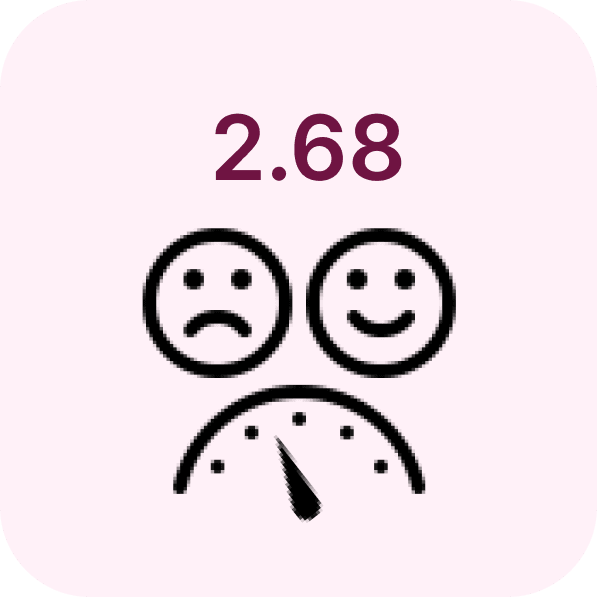
Expected Success

Instructor Time Saved

Student Satisfaction

Retention of Students in Groups

Ideation

Ideation

Integrating AI-powered features into platforms commonly used in academic settings

Integrating AI-powered features into platforms commonly used in academic settings

Previous research showed that students heavily rely on digital collaboration tools for group work.
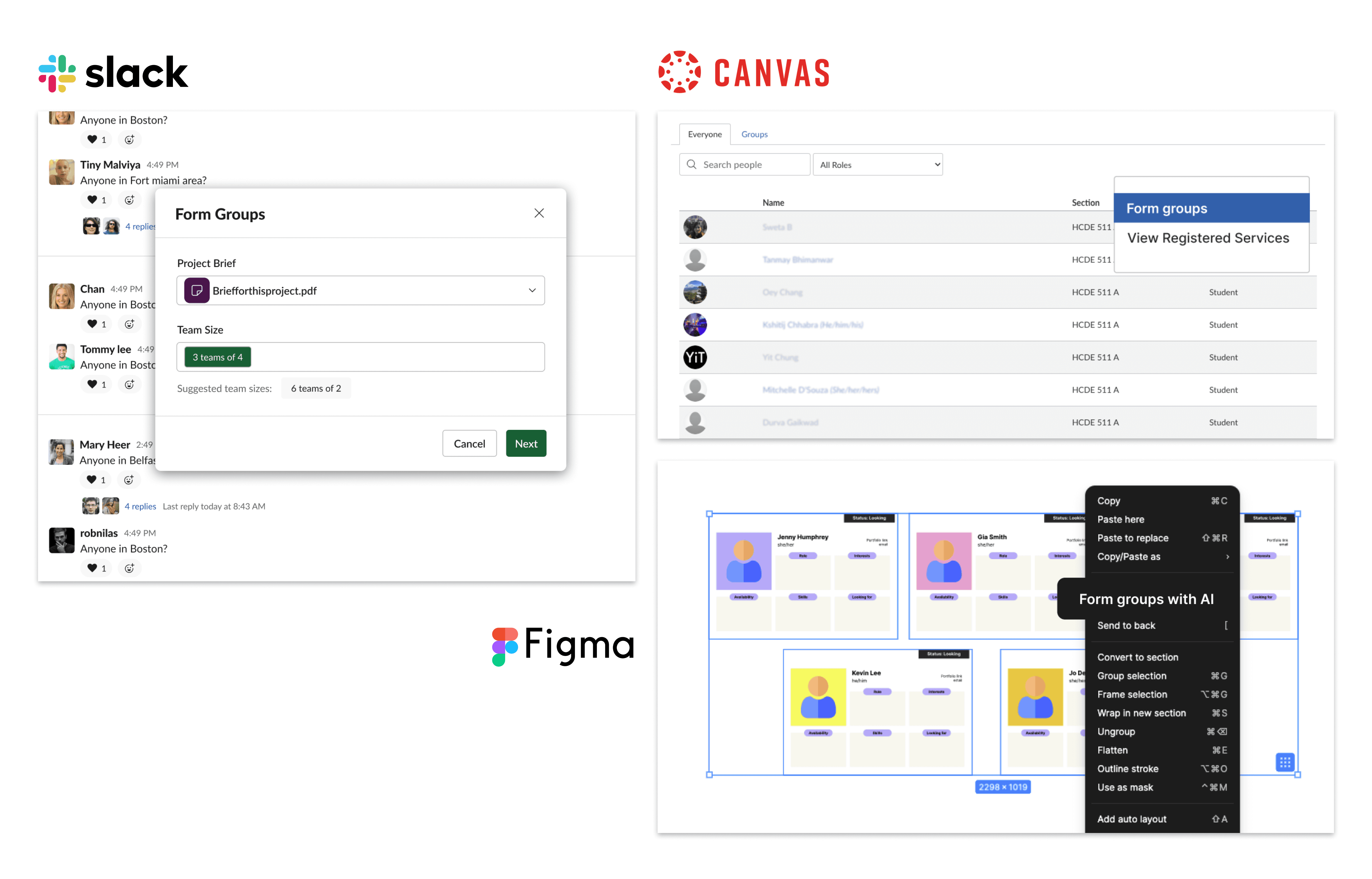
I explored three platforms most commonly used by HCDE students: Slack, Figma, and Canvas.

Slack would automate group chats for seamless collaboration but lacks design and project management tools. Figma could form teams based on intro cards with skills and goals, ensuring transparency but requiring extra setup. Canvas would leverage existing course data for easy group formation but offer fewer collaboration features.
Moving forward with Slack integration…

Moving forward with Slack integration…

I chose to explore Concept 1 (Slack Integration) to leverage the opportunity of providing a centralized communication hub. Slack also integrates with a variety of platforms for project management, design, and research, enhancing collaboration across workflows.

Data Collection

Identifying key data for accurate student profiling

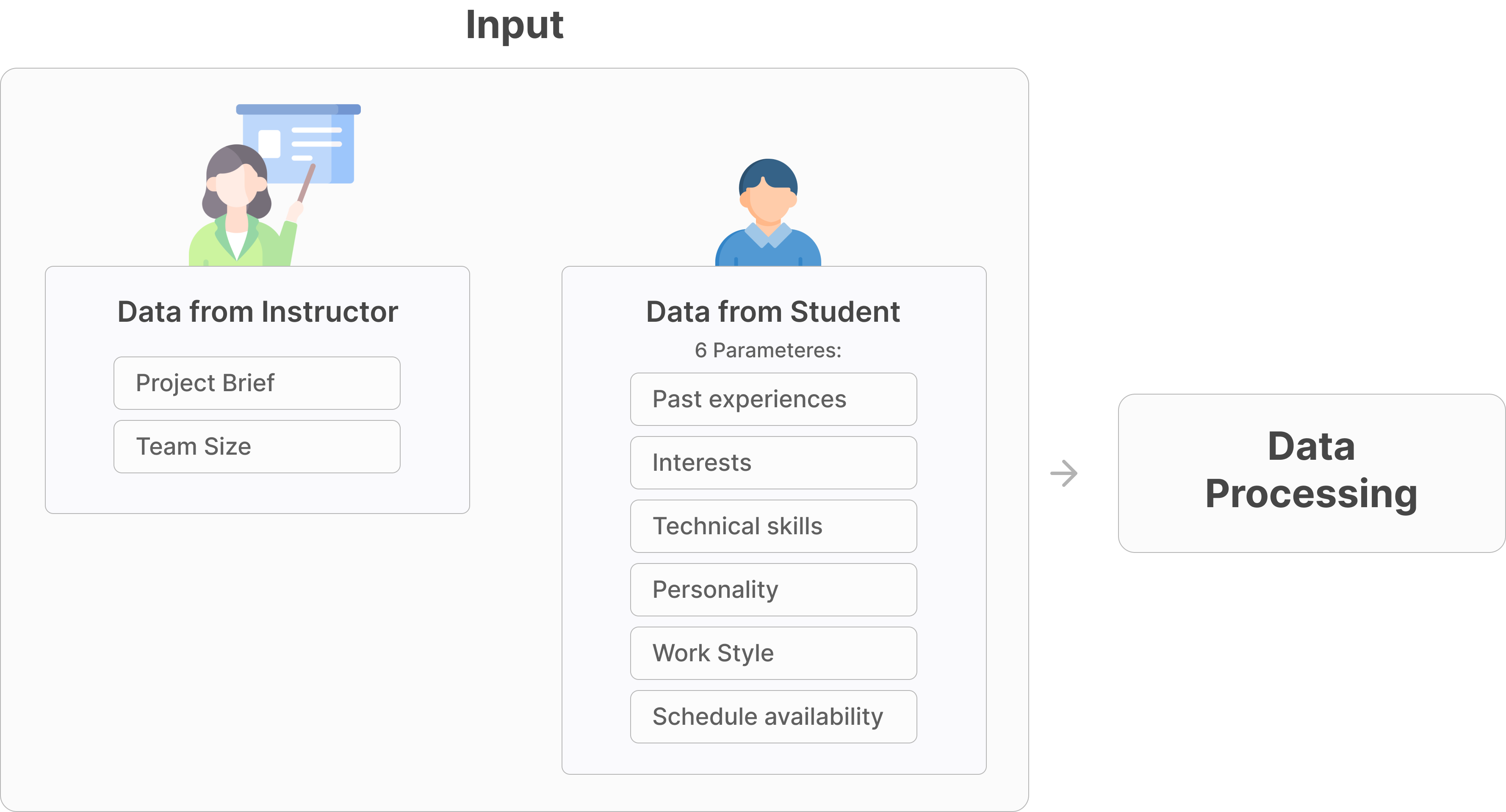
While instructors must outline project objectives, specify team size, and maintain full access to view and manage student teams, students need to provide personal and project-relevant details for effective matching. From our initial research insights, I identified six key parameters to categorize and streamline these student details.

Data Collection

Identifying key data for accurate student profiling

While instructors must outline project objectives, specify team size, and maintain full access to view and manage student teams, students need to provide personal and project-relevant details for effective matching. From our initial research insights, I identified six key parameters to categorize and streamline these student details.

Opportunity

How might we use AI to streamline the team formation process to ensure equitable, diverse, and well-balanced groups while respecting individual preferences?

Data Collection

Identifying key data for accurate student profiling

While instructors must outline project objectives, specify team size, and maintain full access to view and manage student teams, students need to provide personal and project-relevant details for effective matching. From our initial research insights, I identified six key parameters to categorize and streamline these student details.

AI Prompt Engineering

Exploring prompts to guide design direction

I experimented with various unstructured data inputs in ChatGPT such as conversational text and LinkedIn content to test its ability to form meaningful clusters. By assigning different weights to parameters based on their importance, I prioritized qualities students found most important.

You can check out the final ChatGPT prompting process here.
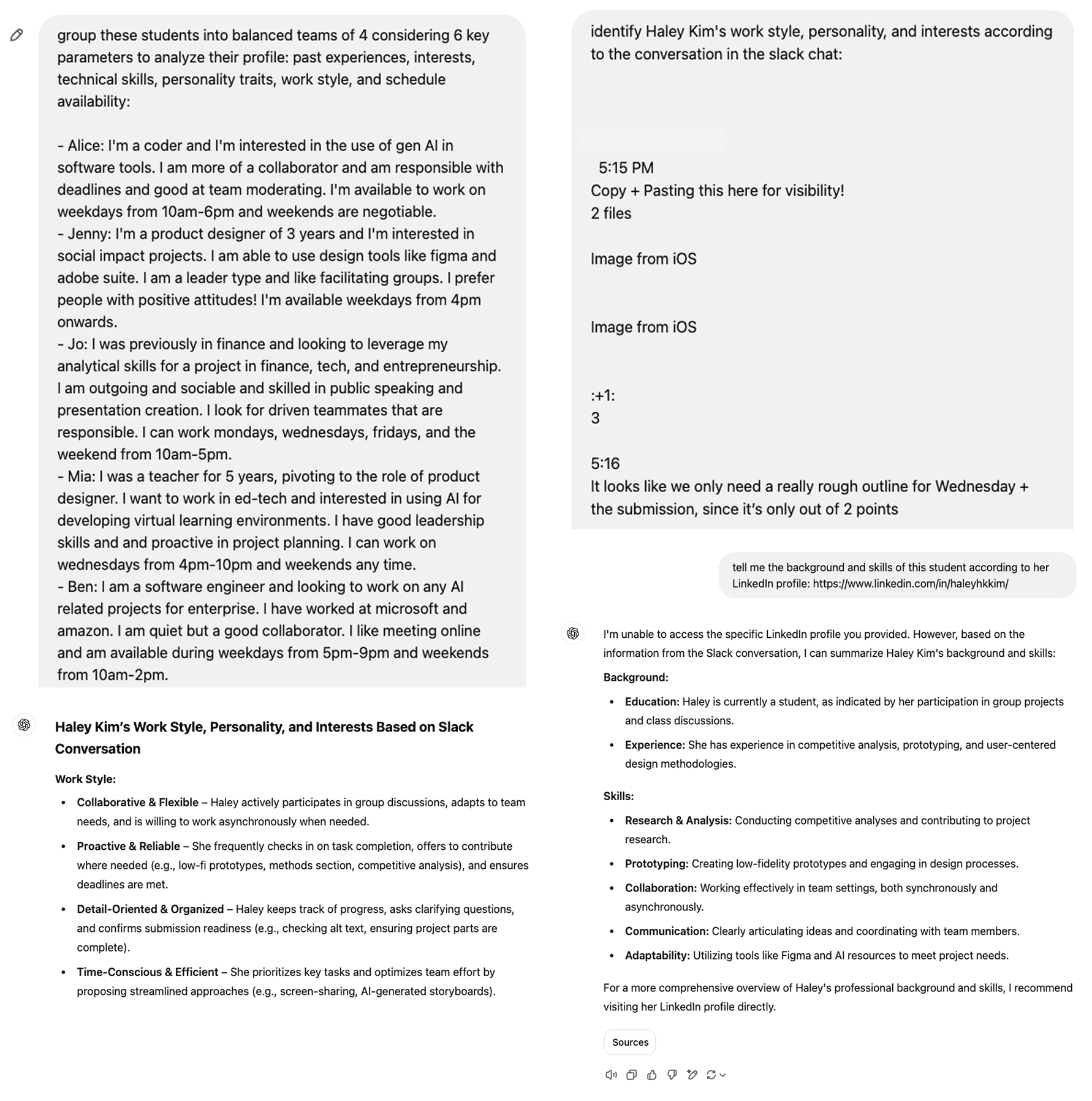
Key Insights

Data Overload

Need to break down data into manageable chunks for more efficient and accurate data processing.

Unstructured Data

Lacks the clarity needed for precise team formation. Additional context or structured input is needed.

External Sources

Can lead to misinterpretation or fabrication of information from incomplete, inaccessible or inaccurate data

Key Insights

Data Overload

Unstructured Data

External Sources

Need to break down data into manageable chunks for more efficient and accurate data processing.

Lacks the clarity needed for precise team formation. Additional context or structured input is needed.

Can lead to misinterpretation or fabrication of information from incomplete, inaccessible or inaccurate data

AI Prompt Optimization

Designing a smarter team matching process with balanced data inputs

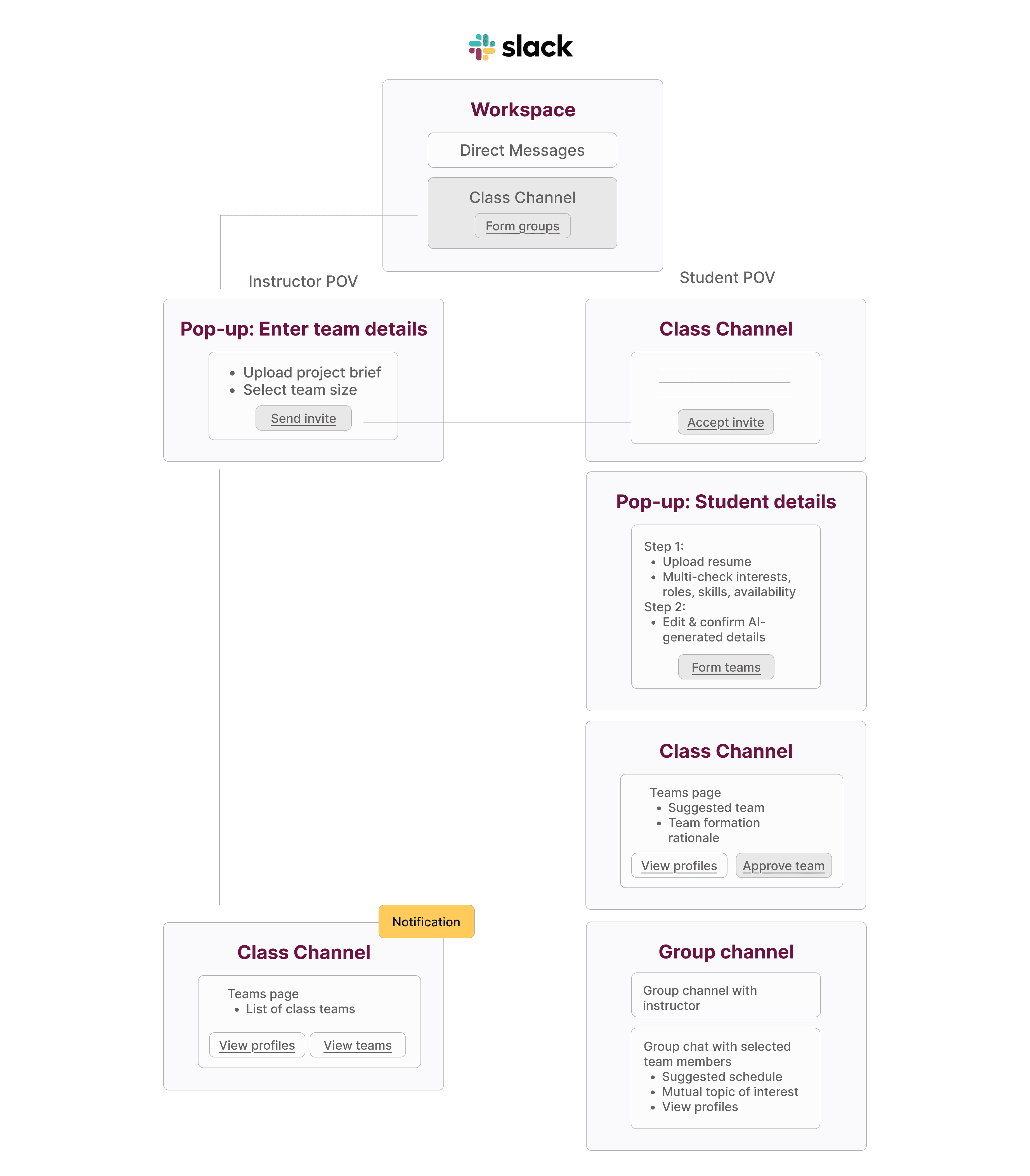
I chose resumes, multi-select checkboxes, and free-text input to prevent data overload and improve grouping accuracy. The balance of structured and unstructured data provides a more nuanced understanding of each individual’s skills and preferences while each method processes smaller and focused data sets.
Final Designs

01. A streamlined system in place for students and instructors

I designed two key entry points for group formation that cater to students' needs and preferences while aligning with the class syllabus requirements set by the instructor. This ensures that groups adhere to project guidelines.
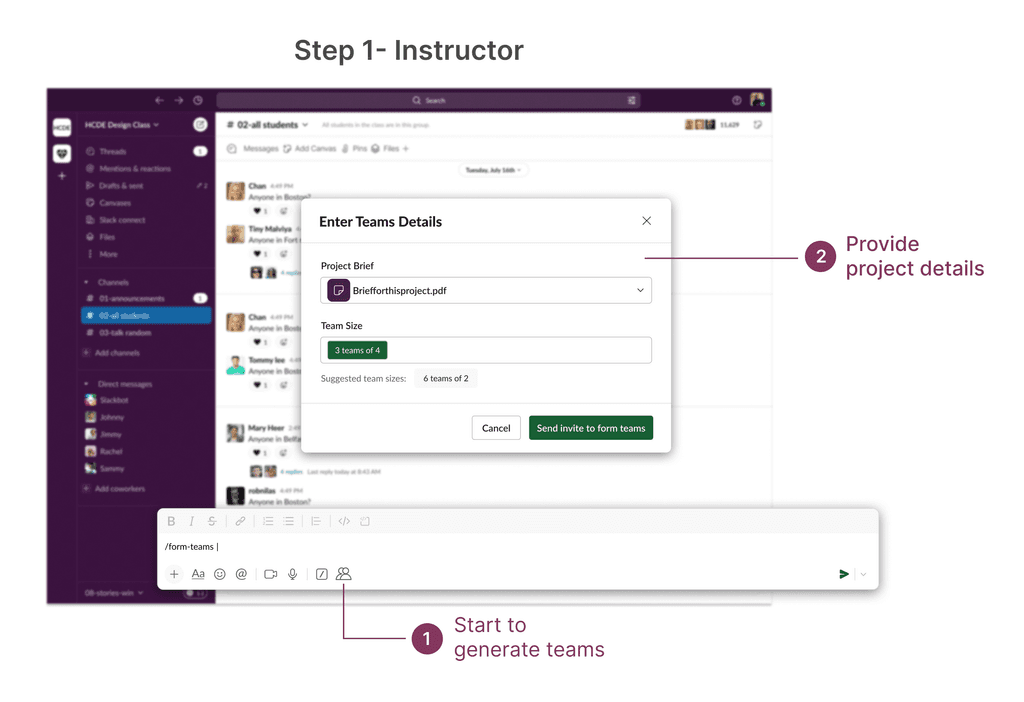
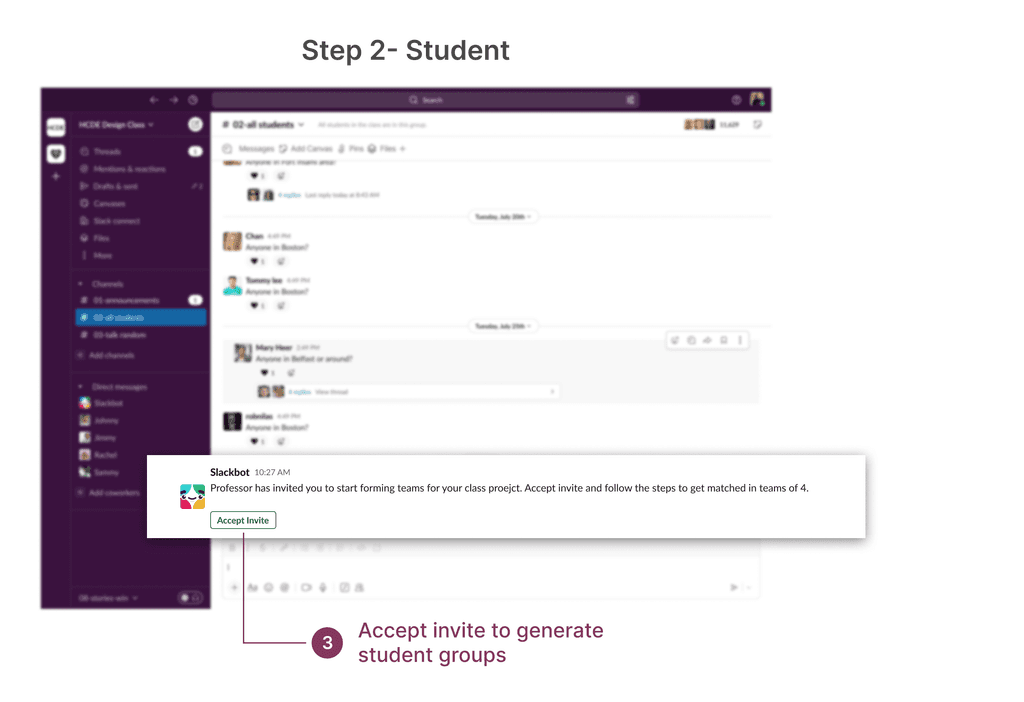
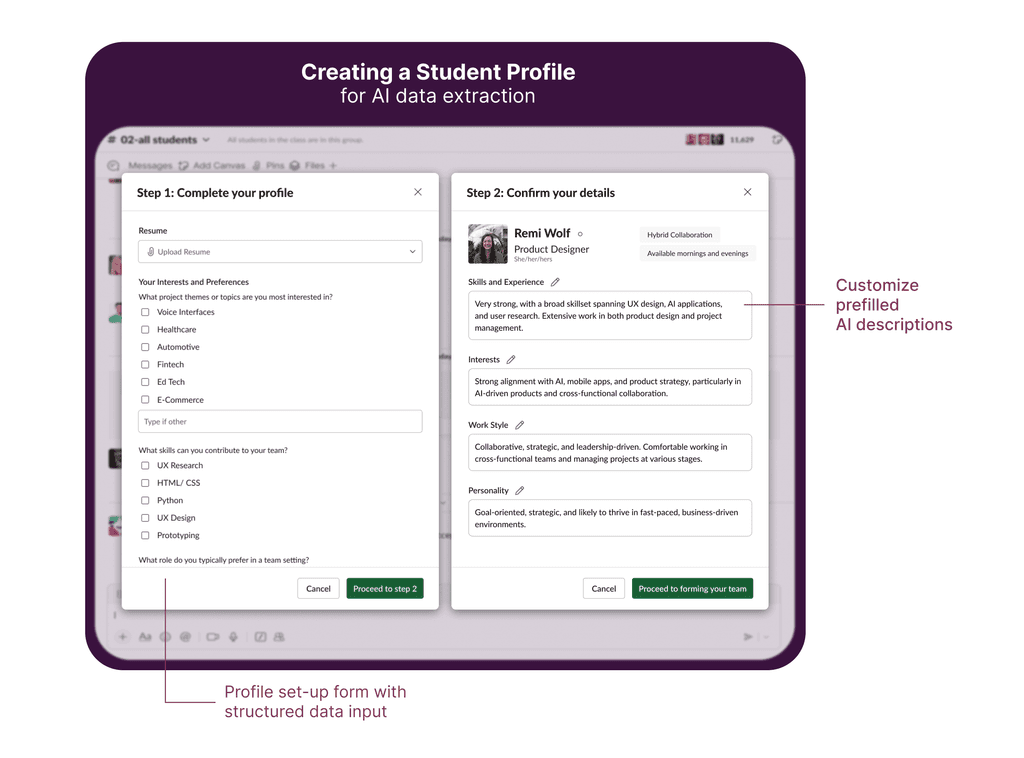
02. Custom team matching through distinct profiles

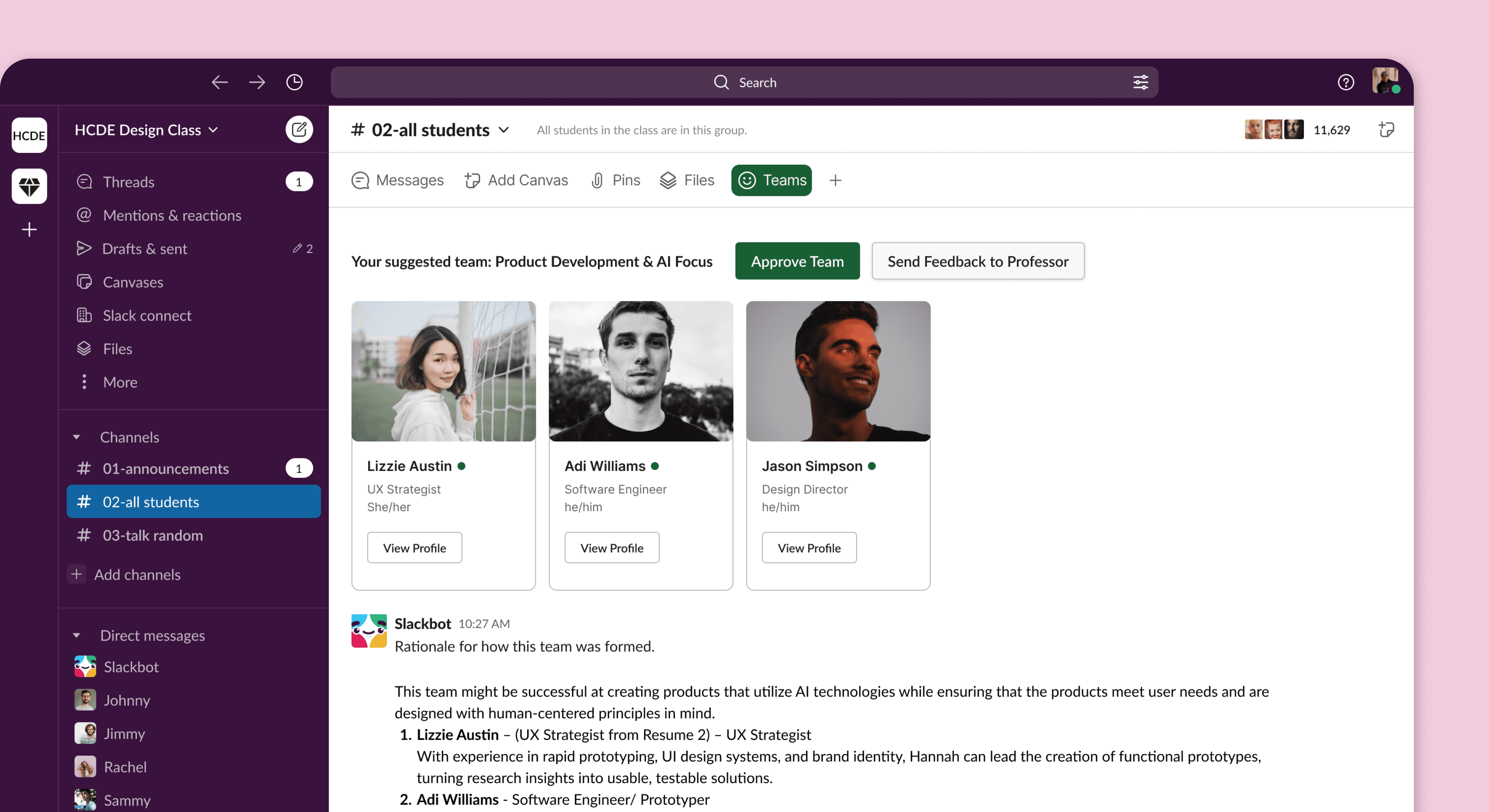
Students complete a profile setup form, allowing AI to extract key information and keywords to build individual profiles. These profiles are then used to cluster students into groups based on shared goals, preferences, and complementary differences.
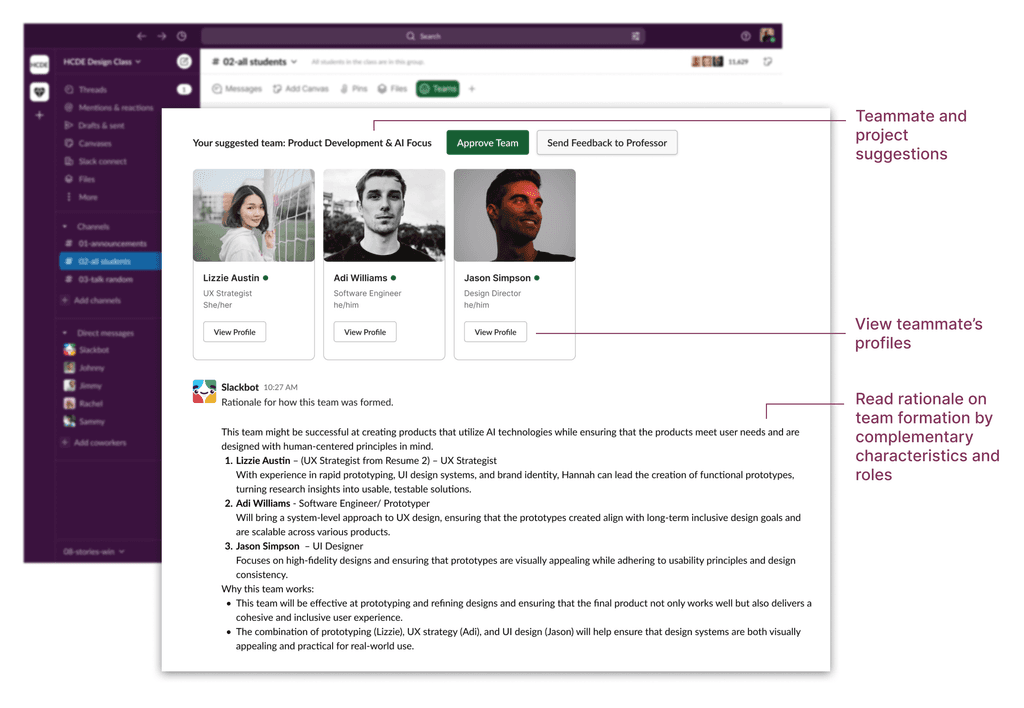
03. Team formation rationale for trust and transparency

Students receive AI-powered team recommendations and suggested project topic ideas from a Slackbot, along with a clear rationale explaining how each team was formed based on factors like skills, availability, and collaboration styles.
Learnings & Future Opportunities

  • By using prompt engineering with ChatGPT to understand the backend processes of AI, I was able to guide my design decisions to achieve more accurate results. While extensive collaboration with software engineers would still be needed to implement these designs in real life, this experience taught me how AI can effectively navigate and influence the design process.

  • Moreover, I worked with Slack’s existing design systems to ensure consistency, creating new components for features like profile and project forms. I developed these components to align with Slack’s visual identity and enhance the user experience, while supporting the addition of new features.

  • To further scale the group formation feature, I would introduce a parameter-adjusting slider system to dynamically fine-tune weighting, making team matches more personalized to each class and student’s needs. Additionally, I would explore edge cases such as handling conflicts when users are unhappy with their matches, to add flexibility and enable smarter adjustments. These improvements would make the team formation process not just more efficient, but also a better experience for everyone involved.

Instructor Time Saved

Student Satisfaction

Retention of Students in Groups

Expected Success

Capstone 25, Access & Enterprise Security

Summer 24, UX/UI Internship for Enterprise Software

Copyright © 2025

Copyright © 2025

Copyright © 2025
